Category

Uncategorized

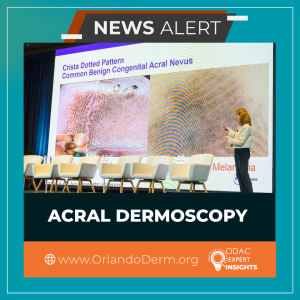
Acral Dermoscopy: ODAC in the News

By Media Coverage, Uncategorized

acral dermoscopy

The challenge of diagnosing acral lesions—those found on the palms and soles—is a familiar one for even the most seasoned dermatologists. Because these areas follow a unique set of “rules” compared to the rest of the body, clinical confidence is paramount to avoiding unnecessary biopsies while catching early-stage melanomas.

The Dermatology Digest highlights an ODAC session on the topic presented by Jennifer Stein, MD, PhD, FAAD, professor and associate vice chair at the NYU Grossman School of Medicine. The article outlines Dr. Stein’s actionable, everyday strategies, including:

  • The Golden Rule: “Furrows are Fine, Ridges are Risky”
  • Acquired Acral Three-Step Algorithm
  • The BRAAFF Algorithm

In the article, Dr. Stein also shares some considerations in patients with darker skin types:

  • Most algorithms may not perfectly translate to patients with darker skin tones.
  • In Fitzpatrick Skin Types V and VI, clinicians may encounter physiologic volar melanocytic macules that display parallel ridge patterns but are entirely benign. While these findings are common in skin of color, Dr. Stein cautioned that the “index of suspicion” must remain high to ensure acral melanoma isn’t overlooked.

Evaluating the nail unit presents its own set of hurdles, as the pigment often originates in the difficult-to-biopsy nail matrix. Dr. Stein breaks down the evaluation into two categories:

  • Non-melanocytic: Before suspecting a tumor, rule out fungal infections (look for a “reverse triangle” pattern) and subungual hemorrhages (look for red-to-black spots with filamentous edges).
  • Melanocytic: Benign ethnic melanonychia often presents with gray, homogeneous lines. However, the “Ugly Duckling” concept is your best friend here. Look for outliers: bands that are wider at the base, involve multiple colors, or cause nail plate destruction.

Dermoscopy is an invaluable tool, but it works best when paired with clinical intuition. By mastering the distinction between furrows and ridges and remaining mindful of how these patterns shift across different skin types, clinicians can provide more accurate, confident care for their patients.

Read the original article posted to The Dermatology Digest.
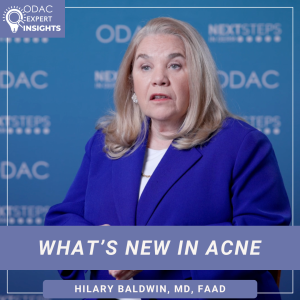
Acne Treatment Advances: ODAC Video Interview

By Uncategorized

acne treatment advances

In a Next Steps in Derm video interview conducted in partnership with the ODAC Dermatology Conference, Hilary Baldwin, MD, FAAD, reviews the latest acne treatment advances, including emerging acne treatments and research breakthroughs. New studies highlight two innovative options: a triple combination topical therapy and the first new acne molecule introduced in 40 years, both designed to target the four key pillars of acne pathophysiology.

In the video, Dr. Baldwin also discusses the benefits of the oral antibiotic sarecycline, which can help patients achieve clearer skin while having a lower impact on the gut microbiome. In addition, she previews promising therapies in development, including a freshwater sponge–derived treatment, a fascin inhibitor, and a therapeutic acne vaccine.

Watch and gain insight into acne treatment advances that may change the future of acne care.

JDD Video Abstract with ODAC Faculty Dr. Hilary Baldwin

By Uncategorized

acneceuticals

ODAC faculty are not only experts in dermatology – many are involved hands-on with the latest dermatologic research.

Case in point: Dr. Hilary Baldwin. A prolific researcher, Dr. Baldwin is a sought-after speaker on a variety of dermatology topics. At ODAC 2026, Dr. Baldwin will share approaches for treating keloids, provide an acne update for 2026, and address the role of cosmeceuticals in barrier repair.

If you’re looking for a sneak peak, check out Dr. Baldwin’s JDD Video Abstract about a recent study in which she was the lead author, “Real-World Clinical Case Series Utilizing Acneceuticals as Monotherapy, Adjunctive, or Maintenance Therapy for Acne Vulgaris.”

Watch as Dr. Baldwin gives the background on the need for and classification of acneceuticals. Find out the real-world data on the effectiveness of acneceuticals in the treatment of acne vulgaris, both as monotherapy and in conjunction with prescription therapies. Learn from Dr. Baldwin on how acneceuticals can help with patient engagement in their treatment. Plus find out her takeaways from the study and how dermatologists may best recommend acneceuticals for their acne patients.

Be sure to register for ODAC to learn from Dr. Baldwin in-person.

Neuromodulator Complications: ODAC Pearls with Dr. Watchmaker

By ODAC Sessions, Uncategorized

neuromodulator complications

At the 2025 ODAC Dermatology Conference, Jacqueline Watchmaker, MD, shared how to assess and manage neuromodulator complications. Here are some highlights from her session:

  • With heavy eyelids, Dr. Watchmaker says it’s crucial to determine whether the issue lies with the brow or the eyelid itself.
  • Brow ptosis is caused by too many units overall in the frontalis, too many units too low or lateral in the frontalis, or diffusion of neuromodulator from the glabellar complex to the lower frontalis.
  • Watchmaker suggests adding units to the depressor muscles (procerus/corrugators/orbicularis oculi) to help lift the brow. Also, with time, she says the neurotoxin’s effects will naturally fade, resolving the brow ptosis without intervention.
  • A “crooked smile” effect can happen when inadvertently injecting the depressor labii inferioris (DLI) muscle. Injecting one unit of the neuromodulator into the contralateral DLI muscle will lessen the effect naturally in a few weeks.
  • A “shelf” appearance under the eye occurs when too much neuromodulator is injected into the orbicularis oculi muscle. This may be prevented by using only 1-2 units for the most inferior injection.
  • Patients also may notice more prominent “sleep lines” post-injection. She recommends patients wear hydrocolloid bandages at night if the lines are bothersome.
  • Watchmaker also debunks several myths that are often shared with patients after neuromodulator injections, including not bending down or lying down for four hours post-injection, or not working out for 24 hours.
  • Watchmaker says there is limited data regarding whether exercising facial muscles or taking oral zinc help prolong a neuromodulator’s duration.

This session summary was written by Vixey Silva, DO, and published on Next Steps in Derm.

Register for ODAC 2026 for more pearls on preventing and managing complications.


ODAC Virtual Pre-Conference Symposium

By Uncategorized
Register Now

There is both science and strategy behind movie coming attractions: Hook the audience with some but not all of the most enticing morsels without spoiling the meal. The same could technically be said about the ODAC Virtual Pre-Conference Symposium, though, biased we may be, it is truly the kick off to ODAC educational greatness. Now in its third year, this interactive case-based program covers a cornucopia of complex topics is coming back with all new faculty and cases. Set your microwave to “pop,” prep a licorice straw for your 48 oz beverage, and enjoy the show with moderator and ODAC Co-Chair Dr. Adam Friedman and esteemed faculty.

Tuesday, November 15th | 5:30 – 7:30 PM ET

Part 1 | 5:30 PM – 6:30 PM ET
Welcome & Introductions with Adam Friedman, MD, FAAD
Challenging Cases of Alopecia with Michelle Oboite, MD
Challenging Cases of Vitiligo with David Rosmarin, MD
Live Audience Q&A

Part II | 6:30 – 7:30 PM ET
Welcome & Introductions with Adam Friedman, MD, FAAD
Atopic Dermatitis in Pediatric Patients with Kaiane Habeshian, MD
Bad Ulcers: When it’s NOT Pyoderma Gangrenosum with Olayemi Sokumbi, MD
Live Audience Q&A

Pre-Con Concludes | 9:00 PM ET

ODAC Dermatology Aesthetic & Surgical Conference – 2022 Attendee Experience

By Uncategorized

ODAC Dermatology, Aesthetic & Surgical Conference is the premier clinical CE dermatology conference expertly curated to provide comprehensive, annual updates and fresh practical pearls in medical, aesthetic and surgical dermatology. Elite faculty provide four days of cutting edge lectures, Q&A, live demonstrations and workshops for today’s dermatology provider.

Attend ODAC to stay informed and up-to-date on clinical dermatology updates, new treatments, new uses for old treatments, new product lines, changes to therapeutic guidelines and to witness live demonstrations from the experts. Unique to ODAC, each presentation focuses on practical pearls you can immediately use in your practice.

ODAC 2023 registration is now open! The event will be held January 13 – 15, 2023 at the JW Marriott Grande Lakes in Orlando, Florida. Register today: https://orlandoderm.org/registration/