
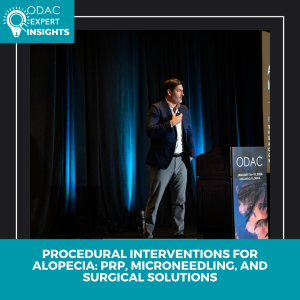
At the ODAC Dermatology Conference, Terrence C. Keaney, MD, delivered a practical, experience-driven update on procedural interventions for androgenetic alopecia (AGA), with a primary focus on platelet-rich plasma (PRP).
Dr. Keaney opened by reframing treatment escalation. “Hair loss is one of the few conditions where the severity of disease does not dictate how aggressively you treat,” he said. “It depends on how much the patient is bothered.” In his practice, patients rate distress from 0 to 10 at intake.
While emphasizing that medical therapy remains foundational, he described PRP as the “mainstay regenerative option” in his clinic. Mechanistically, PRP concentrates platelets that release a “cocktail of growth factors” and cytokines. “If we could isolate the single magic molecule, we’d have a drug,” he noted. “But right now, it’s the combined signal that appears to prevent dermal papilla apoptosis and prolong anagen.”
He acknowledged that data show a treatment signal but stressed variability. “Not everyone responds, and you have to be straightforward about that.” One major factor is biologic fluctuation. “The ‘drug’ in PRP is what’s in the alpha granules of platelets,” he said. “But platelet counts vary by time of day, hydration, diet, age, and sex.” A fasting, highly hydrated morning patient may yield a lower effective concentration than an afternoon, well-fed patient. “You may be delivering different doses without realizing it.”
Preparation differences add further inconsistency. “Not one PRP study uses the exact same protocol,” he said, citing variability in centrifugation, leukocyte content, activation, concentration targets, and treatment intervals. While many clinicians aim for 5–10× physiologic platelet concentration, he emphasized that no single protocol is definitively superior.
In his practice, Dr. Keaney performs three monthly “loading” treatments followed by maintenance every three to six months. “That’s based on experience, not perfect science,” he acknowledged.
On safety, he referenced reports of vision loss after periocular PRP injections. Although no cases have been reported with scalp injections, he remains cautious. “You’re injecting a concentrated clot,” he said, underscoring the importance of vascular awareness and informed consent.
He briefly addressed alternatives. Platelet-rich fibrin (PRF), he suggested, may be less biologically rational for hair loss. On exosomes, he noted the U.S. Food and Drug Administration considers injectable exosomes a drug. “Do not inject exosomes,” he cautioned.
Finally, Dr. Keaney emphasized objective tracking. His clinic uses standardized photography and trichoscopic measurements. “The follow-up becomes easy,” he said. “You can show the patient real data—no debating lighting or styling.”
His takeaway for dermatologists: Procedural therapies can augment medical management of AGA, but success depends on careful patient selection, transparency about variability, and disciplined technique.
This summary was prepared by Dr. Samip Sheth, dermatology resident, who attended the session. The content reflects the resident’s notes and interpretations, may contain errors, and is provided for educational purposes only. It does not constitute official faculty endorsement and should not replace original sources or clinical judgment.