
Monthly Archives

July 2026

Skin Barrier Repair in Acne with Cosmeceuticals

By ODAC Sessions

skin barrier repair in acne

Acne is a barrier deficiency disorder, according to Brooklyn, N.Y., dermatologist Dr. Hilary Baldwin. Next Steps in Derm, in partnership with the ODAC Dermatology Conference, interviewed Dr. Baldwin, who addresses the role of skin care in acne improvement. Find out why better products and vehicles could be the reason for the increasing placebo effect in acne studies. Find out the impact of acne treatments on the skin barrier and how this affects non-compliance. Hear what Dr. Baldwin says must happen in every acne visit. Plus learn the origin of the new term “acneceuticals” and what the latest research shows on the role of non-prescription active ingredients in acne care.


Further Reading

If you want to read more about cosmeceuticals for acne, check out the following articles published in the Journal of Drugs in Dermatology:

The Use of Acneceuticals to Improve Acne Care: Introduction of a New Term and Review of the Literature

ABSTRACT

Background: Acne is a multifactorial inflammatory skin condition that commonly presents to the dermatology clinic. Treatment generally involves the use of pharmaceutical agents and procedural techniques. Recently, the importance of over-the-counter skin care in acne

has been recognized in many studies. This paper introduces the term acneceuticals to encompass a wide range of FDA monographed, yet non-prescription ingredients proven to alter the structure and function of acneic skin.

Methods: A panel of 8 dermatologists with an interest in acne and skin care performed a literature review of active skin care in acne. The role of acneceuticals in the treatment of acne — as monotherapy, adjunctive, and maintenance therapy — was evaluated using a modified Delphi approach. Studies were limited to in vivo human trials involving acne. Individual actives were assessed separately.

Results: The quality of evidence was moderate-to-low for many of the ingredients. Most of the actives included in the final assessment had been studied in vehicle-controlled, blinded, often comparative studies but enrolled a small number of subjects. In these studies, the acneceuticals were found to reduce lesion count, reduce sebum production, and improve efficacy of existing pharmacologic therapies.

Conclusion: Acneceuticals have demonstrated benefits in treating acne, alone or in conjunction with established pharmaceutical agents. These data allow us to make quality recommendations for our patients that should be a part of every patient encounter. The recommendations also serve as a guide for patients searching the internet for beneficial self-care products.

Real-World Clinical Case Series Utilizing Acneceuticals as Monotherapy, Adjunctive, or Maintenance Therapy for Acne Vulgaris

ABSTRACT

Background: Acne vulgaris is a common, multifactorial inflammatory skin disease for which there are many pharmacologic and procedural interventions. Recent publications have stressed the importance of quality skin care containing non-prescription actives (acneceuticals) in the treatment of this chronic disorder. Acne therapy is made more complicated by the diversity of presentation that includes age, gender, race, underlying skin type, product adherence, lesion morphology, and severity.

Methods: A panel of 6 dermatologists with expertise in the treatment of acne met twice for consensus conferences in March and November 2024. Discussion included the generation of 13 common disease presentations, the identification of potential cases to illustrate the presentations, and the design of 2-month case studies utilizing acneceuticals. Panelists chose new or established patients in their care who fit into the predetermined categories, provided them with the agreed-upon acneceuticals, and followed them for 2 months.

Results: Ten cases were chosen to comprise the most common therapeutic crossroads where pharmacologic or procedural interventions were not providing satisfactory control. This case study series included patients who were medication-intolerant, failing internet cures, not fully responsive to their current regimen, adult female acne patients with concomitant aging concerns, those needing maintenance therapy, and patients with issues regarding access to care.

Conclusions: Acneceuticals were found to play an important role as monotherapy, adjunctive therapy, and maintenance therapy for acne patients. The 10 cases elucidated the ability of these over-the-counter (OTC) actives to improve patient care under several clinical scenarios.

Did you enjoy this video interview? Find more here.

Beyond “Ozempic Face”: JDD Buzz Commentary

By Aesthetic Dermatology

Ozempic face

If you’ve spent time in clinic recently, you’ve undoubtedly heard it. A patient points to a newly gaunt appearance and asks, “Is this because of my weight loss medication?”

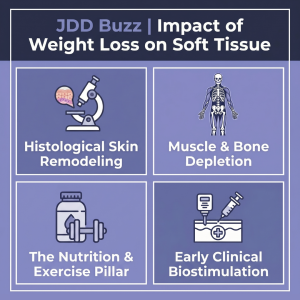
While the social media buzz around “Ozempic face” dominates patient conversations, the clinical reality is far more nuanced. A narrative review in the Journal of Drugs in Dermatology evaluated the evidence behind the impact of rapid weight loss on soft tissue and shared guidance for dermatologists in counseling and treating weight loss patients.

In an interview with Next Steps in Derm, authors Sam Fathizadeh, BS, Dr. Melanie D. Palm, and Dr. Deirdre Hooper address the “attribution bias,” where patients—and even some clinicians—frequently blame GLP-1 drugs directly for skin laxity and volume loss. However, studies comparing bariatric surgery, dietary changes, and GLP-1 therapies show broadly similar effects on soft tissue. The primary driver of these changes is the rate and magnitude of rapid weight loss itself, regardless of the method.

The review highlights one area where GLP-1 agents may have a drug-specific effect: dermal white adipose tissue (dWAT). This specialized fat layer is closely integrated with the dermis and directly impacts skin thickness and facial volume. Early data suggests GLP-1 signaling may influence dWAT independently of overall fat loss—a key area of ongoing research for dermatologists.

Questions about weight loss and soft tissue will only multiply as GLP-1 indications expand. Check out the full interview and dive into the original article in the Journal of Drugs in Dermatology to stay ahead of the curve.

Prurigo Nodularis: How to Treat

By Medical Dermatology

prurigo nodularis

With two FDA-approved therapies now available, it’s hard to believe that prurigo nodularis (PN) was only recently considered a unique dermatologic condition. In this Next Steps in Derm video interview, in partnership with the ODAC Dermatology Conference, ODAC Conference Co-Chair Adam Friedman, MD, FAAD, shares both the history and current state of PN treatment. Watch and learn if using dupilumab or nemolizumab is a slam dunk or if combination therapy may be needed for full clearance. Learn if there’s still a role for topical therapies in the age of systemics. Plus find out what’s coming down the PN pipeline.

Further Reading

If you want to read more about prurigo nodularis, check out the following articles published in the Journal of Drugs in Dermatology:

New Horizons in Our Understanding of Prurigo Nodularis and Its Management

ABSTRACT

Prurigo nodularis (PN) was first accurately described more than a century ago by Hyde and Montgomery as chronic itchy nodules commonly noted in symmetric distribution on extensor sites of limbs, upper back, and abdomen.1 For decades PN patients were among the most challenging to treat as they suffer from intractable itch that affects their sleep dominates their daily life activities and causes many psychological comorbidities such as mood disorders including anxiety, stress, and depression. In the last decade, significant advances in our understanding of the pathophysiology of PN have been achieved suggesting this condition involves mainly type 2 immune dysregulation and abnormal neural sensitization, which led to the development of new targeted treatments.

Management of Prurigo Nodularis

ABSTRACT

Background: Prurigo nodularis (PN) is a chronic disease characterized by intense pruritus and nodular lesions associated with reduced quality of life. Until recently, no US Food and Drug Administration (FDA)-approved therapies have been available for the management of PN. Treatment regimens have been highly variable and clinical management guidelines are lacking overall; formal treatment guidelines do not exist within the US. In 2022, dupilumab became the first FDA-approved medication for PN. Multiple novel agents that target the neuroimmune underpinnings of the disease are currently in development and show promise for this challenging disorder.

Objective: To review current treatments and emerging therapies for effective management of patients with PN.

Methods: We reviewed publications on PN management identified from PubMed, Embase, Web of Science, and the Cochrane Library. We also included publicly available data on clinical trials for PN therapies reported on the US National Library of Medicine ClinicalTrials.gov, the International Conference on Harmonisation-Good Clinical Practice (ICH-GCP) Database, and the European Clinical Trials (EudraCT) Database.

Results: The recommended management of PN begins with an assessment of disease severity, including disease burden and pruritus intensity, and evaluation of comorbid medical disorders. Treatment goals include resolution of itch, improvement in nodules or cutaneous lesions, and improvement in quality of life. Therapies should be selected based on a patient’s clinical presentation and comorbidities. Treatment should simultaneously address the neural and immunologic components of PN. Combination therapy, particularly with conventional agents, may be beneficial.

Limitations: Data on most conventional PN treatments are limited to anecdotal reports, small clinical trials, or expert consensus recommendations. No head-to-head comparative trials have evaluated the relative efficacy of conventional and/or emerging agents, or combination therapy.

Conclusion: An effective treatment approach for patients with PN should reduce pruritus, allow nodular lesions to heal, and improve individual quality of life. The treatment landscape for PN is rapidly evolving with one FDA-approved agent and several new promising therapies on the horizon.

Did you enjoy this video interview? Find more here.