
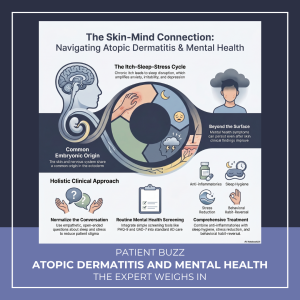
Dermatologists are experts at treating what is visible. But as highlighted in a recent article by Everyday Health, there is an “invisible burden” of atopic dermatitis (AD) that cannot be seen on the skin’s surface: the profound toll it takes on a patient’s mental health.
Because AD is a psychophysiological disorder, psychological stress actually triggers inflammation that worsens flares, creating a frustrating, vicious cycle. Chronic itch and sleep disturbances quickly compound this distress, frequently leading to anxiety, depression, and irritability.
Yet a major gap remains in patient care. Patients often hesitate to bring up their mental health during an office visit, and many dermatologists feel unequipped or too pressed for time to broach the topic.
To bridge this gap, read this Next Steps in Derm interview with Mohammad Jafferany, MD, DFAPA, MCPS, a professor of psychodermatology, psychiatry, and behavioral sciences. He shares practical, clinical insights that every dermatologist can implement today. From understanding the bidirectional connection to normalizing the mental health.
