
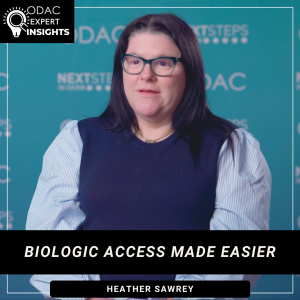
Accessing biologics is a process that can be complicated for both the dermatology office staff and patients. Next Steps in Derm, in partnership with the ODAC Dermatology Conference, interviewed Heather Sawrey, biologic coordinator for the George Washington University School of Medicine & Health Sciences Department of Dermatology. With more than 15 years of experience as a biologic coordinator in dermatology, she knows what’s needed for speedy biologic access. Watch and learn what you need to know about the approval timeline and fulfillment steps. Find out the biggest barrier in getting patients on biologics and the value of a “beefy note.” Feeling overwhelmed already? Hear how adding a biologic coordinator to your staff can help ease the burden and improve access.
Further Reading
If you want to read more about biologic access, check out the following articles published in the Journal of Drugs in Dermatology:
ABSTRACT
Background: Conflicting evidence exists regarding the role of race in access to biologics for patients with psoriasis. Objective: To compare biologic use among adult and pediatric United States psoriasis patients of different racial backgrounds.
Methods: Population-based study of US psoriasis patients using the 2003 to 2018 Medical Expenditure Panel Survey (MEPS).
Results: Among 31,525,500 adults and children with psoriasis (weighted), 3,026,578 (9.6%) were on biologics. Among psoriasis patients, 27,464,864 (87.1%) self-identified as white, 2,033,802 (6.5%) self-identified as Black, 1,173,435 (3.7%) self-identified as Asian or Pacific Islander, and 853,399 (2.7%) self-identified as other races. Among those on biologics, 2,778,239 (91.8%) self-identified as white, 84,971 (2.8%) identified as Black, 89,452 (3.0%) self-identified as Asian or Pacific Islander, and 73,917 (2.4%) self-identified as other races. Multivariate logistic regression revealed no significant differences in biologic access between whites and non-whites after adjusting for sociodemographic factors including insurance status (OR for Blacks: 0.347 [0.118, 1.021], P=0.055; OR for Asians: 0.616 [0.240, 1.579], P=0.311; OR for other races: 0.850 [0.216, 3.336], P=0.814.
Conclusion: The results of this study suggest that race alone is not independently associated with access to biologics among adult US psoriasis patients. Additional studies are necessary to evaluate factors independently associated with biologics access among adults and children with psoriasis in the US.
ABSTRACT
Background: Limited analyses of social media content among psoriasis (PsO) and psoriatic arthritis (PsA) patients exist. These patients may turn to social media to gain insight into treatments such as biologics.
Objectives: This study aims to analyze the content, sentiment, and engagement of social media posts regarding biologics for PsO and PsA.
Methods: Posts and comments discussing biologics were extracted from publicly accessible PsO and PsA Reddit groups. Posts were assigned higher (HOT) and lower order (LOT) themes, sentiments, and engagement scores.
Results: Of 1141 posts extracted, 705 posts were classified under the HOT general/efficacy. Twelve lower order themes (LOTs) were identified: general advice/experience (10.2%), symptoms improved (36.6%), switching biologics (10.5%), and time to results (13.4%). 61.3% of content was of positive sentiment, 24.0% was neutral, and 14.7% was of negative sentiment. The mean sentiment score, defined as the average of all posts’ sentiment scores (where negative=-1, neutral=0, and positive=1), was overall positive at 0.47, 95% CI [.41-.52]. Mean sentiment scores between LOTs were significantly different (P<0.001). Information regarding biologics on Reddit is mostly positive; however, there remains a significant number of users expressing dissatisfaction with their efficacy or with biologics in general. Many users sought anecdotal advice.
Conclusion: These findings can help guide educational efforts to anticipate concerns and appease hesitancy regarding biologics and their efficacy.
Did you enjoy this video interview? Find more here.
