
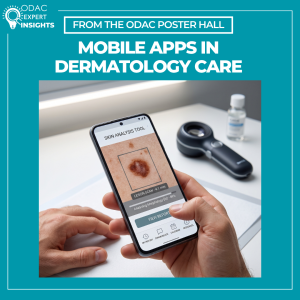
There’s an app for almost everything these days, and dermatology care is no exception. Mobile apps can help patients log symptoms of inflammatory skin diseases, track mole progression, and protect their skin from the sun. In addition, dermatology clinicians can use mobile apps to review data and images from patients, and track a patient’s symptoms over time. While these mobile apps hold great promise, data about their usefulness and effectiveness has been hard to determine. Most research studies about dermatology mobile apps lump them in with other teledermatology methods, making their specific value unclear.
A poster presented at ODAC evaluated mobile dermatology apps independently of teledermatology. I interviewed poster author Julianna Gregory, BSN, of the Florida State University College of Medicine.
What led you to investigate mobile dermatology apps outside of teledermatology?
While teledermatology has been studied fairly extensively, I noticed that mobile dermatology apps offering self-assessment, education, or AI-assisted triage without direct clinician involvement were often lumped into teledermatology or ignored altogether. Yet these apps are increasingly used by patients as a first point of contact, particularly in settings with limited access to dermatologists. That disconnect pushed me to look at them as a distinct modality with different assumptions, risks, benefits, and equity implications than traditional teledermatology.
What are some potential ways mobile apps can enhance dermatology care, both from a patient and clinician perspective?
For patients, apps can improve access to care by providing education, symptom tracking, and preliminary guidance without requiring immediate in-person visits. They empower users to monitor chronic conditions, recognize changes over time, and seek care promptly for concerning features, while reducing barriers related to cost, travel, and wait times, particularly in underserved or rural settings.
For clinicians, apps can streamline intake, standardize image capture, and support triage. They help prioritize urgent cases, facilitate longitudinal monitoring between visits, and reinforce patient education and treatment adherence. When thoughtfully integrated, apps can reduce clinic burden while preserving clinician oversight and improving continuity of care.
Your literature review looked at studied apps currently in use. What did you discover?
Most dermatology mobile applications function as assistive tools rather than replacements for clinical care. They generally fall into two groups: patient-facing apps focused on education, self-monitoring, prevention, and symptom tracking, and clinician-facing tools that support decision-making, triage, and longitudinal monitoring. Disease-specific apps for chronic inflammatory conditions, such as psoriasis and eczema, were associated with improved treatment adherence and quality of life, while prevention-focused apps increased rates of skin self-examination, and promoted positive sun protection and melanoma awareness behaviors.
Examples from our study include SkinVision and Mole Monitor, which help users track lesions, receive reminders for self-examinations, and access educational content, supporting early detection and preventive engagement. Disease-specific apps like Svendsen’s Psoriasis App and CRUSE for chronic urticaria allow patients to log symptoms, monitor treatment, and communicate progress with clinicians, enabling informed discussions during appointments. Clinician-facing apps like SkinTracker provide portals for reviewing patient-submitted data and images for remote monitoring and research, while CRUSE allows longitudinal symptom monitoring to guide management decisions. Together, these apps enhance patient engagement, support clinician oversight, and strengthen the patient-clinician partnership.
There are a lot of apps on the market that make a lot of claims of purported benefits. What does your review reveal about the effectiveness of these dermatology mobile apps?
Our review suggests that apps designed for targeted purposes—treatment adherence, symptom tracking, education, or prevention—demonstrate the most consistent benefits. For example, a psoriasis support app showed 65% adherence to topical Cal/BD foam at four weeks versus 38% in controls (P = 0.004), with greater reductions in disease severity on the LS-PGA scale. Prevention and self-monitoring apps like Mole Monitor and UMSkinCheck increased skin self-examination rates, and photoaging apps were linked with improved sun protection behaviors in adolescents. The CRUSE app logged over 25,000 symptom observations from more than 2,500 users, showing strong engagement in real-world tracking.
Apps that claim to independently diagnose or triage skin disease, particularly AI-driven tools, generally lack robust validation across diverse populations. Overall, the literature supports dermatology apps as adjuncts to care when purpose-specific, evidence-informed, and integrated with clinician oversight, but not as stand-alone diagnostic tools.
Your review also looked at AI integration in these apps. How prevalent was AI integration, and how helpful was the AI component to these apps?
AI integration was present in a small subset of apps. Out of 19 studies, four incorporated AI features, including Agostini 2024, Udrea 2020, Thissen 2017, and AI-assisted lesion assessment apps such as SkinVision. These apps used machine learning or deep learning to assist with lesion assessment, risk stratification, and preliminary triage. The majority of apps, however, focused on education, symptom tracking, treatment adherence, prevention, or patient engagement without AI.
In AI-enabled apps, the technology functioned as an adjunct to clinical care, providing preliminary assessments, highlighting potentially concerning changes, and prompting patients to seek timely professional care. Udrea 2020 reported 80–90% accuracy in triaging suspicious lesions, and Thissen 2017 showed ~95% sensitivity for detecting malignancy in pigmented and non-pigmented lesions. These features enhanced patient engagement, supported monitoring of high-risk conditions, and facilitated more informed interactions with clinicians. When implemented thoughtfully, AI can support early detection, improve self-monitoring, and streamline clinical decision-making, but it remains complementary to traditional care.
What should dermatologists take away from the results of your study?
Dermatologists should recognize that mobile applications are becoming an ever-present part of patient care, and many patients will use them regardless of clinical involvement. These apps can support education, self-monitoring, prevention, and treatment adherence, particularly for chronic conditions like psoriasis or eczema and for skin cancer prevention. Clinician-facing and AI-enabled apps can further assist with monitoring, triage, and early lesion assessment, complementing rather than replacing professional care.
To stay ahead, dermatologists can actively recommend and integrate validated, evidence-based apps identified in the literature, ensuring that patients use tools that are safe, effective, and clinically informed. By doing so, clinicians can enhance patient engagement, improve adherence, and support more informed clinical decisions, positioning themselves at the forefront of digital dermatology rather than reacting to its adoption by patients.
Additional authors of the poster include:
Beatriz Fernandes, BS, Florida State University College of Medicine
Anna Marchus, BS, Florida State University College of Medicine
Jessica Houpe, MD, University of Central Florida/HCA Healthcare Consortium
