
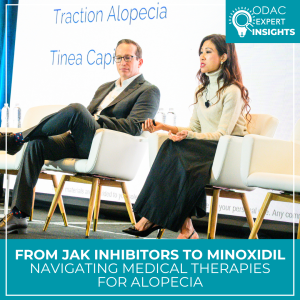
At the ODAC Dermatology Conference, Jennifer Soung, MD, FAAD, and Adam Friedman, MD, FAAD, outlined practical treatment strategies for alopecia, emphasizing clear thresholds for systemic therapy, realistic timelines for regrowth, and early use of combination regimens.
The session opened with a 42-year-old woman with five years of diffuse alopecia. Because nonscarring alopecias—including androgenetic alopecia, telogen effluvium, traction alopecia, tinea capitis, and alopecia areata—can appear similar, biopsy may be necessary when the diagnosis is unclear. In this case, biopsy confirmed alopecia areata, and treatment was initiated with ritlecitinib 50 mg once daily.
Severity assessment guides escalation of therapy. Patients with ≥50% scalp hair loss meet criteria for severe alopecia areata, though systemic therapy may also be appropriate in patients with 21–50% scalp loss and significant psychosocial impact. Clinical trial data show heterogeneous response times to JAK inhibitors: about 33% of patients respond within 12 weeks, 28% between 12–36 weeks, and 8% between 36–52 weeks, while roughly 31% may not respond after one year. Patients with ≥95% scalp hair loss or disease duration ≥4 years are more likely to be late responders.
Combination therapy is frequently required. In one case, recurrent patches developed seven months after starting ritlecitinib 50 mg daily. Adding low-dose oral minoxidil led to near-complete regrowth within three to four months. In practice, low-dose oral minoxidil is commonly started at 0.625 mg daily in women and about 1–1.5 mg daily in men, with titration depending on response.
Large cohort data suggest the drug is well tolerated. In a study of 1,404 patients, hypertrichosis occurred in 15.1%, lightheadedness in 1.7%, fluid retention in 1.3%, tachycardia in 0.9%, and headache in 0.4%; only 1.7% discontinued therapy due to adverse effects. Oral minoxidil should generally be avoided in patients with angina, heart failure, arrhythmias, pericarditis, pregnancy, or pheochromocytoma.
For female pattern hair loss, antiandrogen therapy is often combined with minoxidil. Spironolactone is typically prescribed at about 100 mg daily (range 25–200 mg) and may be used alone or with topical minoxidil 5% foam nightly. Clinical improvement generally requires at least 12 months of therapy and correlates with baseline disease severity.
Persistent chemotherapy-induced alopecia, defined as hair loss lasting more than six months after chemotherapy, was also discussed. First-line therapy includes topical minoxidil 2–5% or oral minoxidil beginning at 0.5–1.25 mg daily, titrated up to 5 mg if needed. If response is inadequate, spironolactone around 100 mg daily can be added. Eyebrow or eyelash loss may respond to topical bimatoprost 0.03% daily. Finasteride and dutasteride should generally be avoided in patients with hormone-sensitive breast cancer.
Scarring alopecias, such as frontal fibrosing alopecia and lichen planopilaris, require early anti-inflammatory therapy. Common regimens include potent topical corticosteroids, intralesional triamcinolone injections every 4–8 weeks (5–10 mg/mL), and doxycycline 100 mg twice daily for three months followed by anti-inflammatory dosing. Refractory disease may require hydroxychloroquine (<5 mg/kg/day), methotrexate 12.5–25 mg weekly, mycophenolate mofetil ~1 g twice daily, or pioglitazone 15 mg daily.
Drs. Soung and Friedman emphasized that alopecia treatment often requires layered therapy and patience. Meaningful regrowth typically occurs over months rather than weeks, and combining systemic and adjunctive therapies frequently produces the best outcomes.
This information was presented at the 2026 ODAC conference by Adam Friedman, MD, FAAD, and Jennifer Soung, MD, FAAD. The above highlights from this lecture were written and compiled by Samip Sheth, MD.
