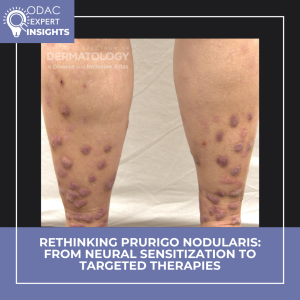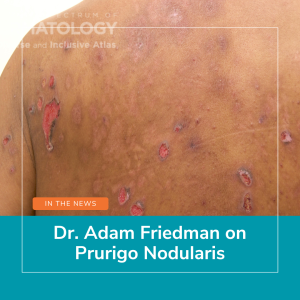
With two FDA-approved therapies now available, it’s hard to believe that prurigo nodularis (PN) was only recently considered a unique dermatologic condition. In this Next Steps in Derm video interview, in partnership with the ODAC Dermatology Conference, ODAC Conference Co-Chair Adam Friedman, MD, FAAD, shares both the history and current state of PN treatment. Watch and learn if using dupilumab or nemolizumab is a slam dunk or if combination therapy may be needed for full clearance. Learn if there’s still a role for topical therapies in the age of systemics. Plus find out what’s coming down the PN pipeline.
Further Reading
If you want to read more about prurigo nodularis, check out the following articles published in the Journal of Drugs in Dermatology:
New Horizons in Our Understanding of Prurigo Nodularis and Its Management
ABSTRACT
Prurigo nodularis (PN) was first accurately described more than a century ago by Hyde and Montgomery as chronic itchy nodules commonly noted in symmetric distribution on extensor sites of limbs, upper back, and abdomen.1 For decades PN patients were among the most challenging to treat as they suffer from intractable itch that affects their sleep dominates their daily life activities and causes many psychological comorbidities such as mood disorders including anxiety, stress, and depression. In the last decade, significant advances in our understanding of the pathophysiology of PN have been achieved suggesting this condition involves mainly type 2 immune dysregulation and abnormal neural sensitization, which led to the development of new targeted treatments.
Management of Prurigo Nodularis
ABSTRACT
Background: Prurigo nodularis (PN) is a chronic disease characterized by intense pruritus and nodular lesions associated with reduced quality of life. Until recently, no US Food and Drug Administration (FDA)-approved therapies have been available for the management of PN. Treatment regimens have been highly variable and clinical management guidelines are lacking overall; formal treatment guidelines do not exist within the US. In 2022, dupilumab became the first FDA-approved medication for PN. Multiple novel agents that target the neuroimmune underpinnings of the disease are currently in development and show promise for this challenging disorder.
Objective: To review current treatments and emerging therapies for effective management of patients with PN.
Methods: We reviewed publications on PN management identified from PubMed, Embase, Web of Science, and the Cochrane Library. We also included publicly available data on clinical trials for PN therapies reported on the US National Library of Medicine ClinicalTrials.gov, the International Conference on Harmonisation-Good Clinical Practice (ICH-GCP) Database, and the European Clinical Trials (EudraCT) Database.
Results: The recommended management of PN begins with an assessment of disease severity, including disease burden and pruritus intensity, and evaluation of comorbid medical disorders. Treatment goals include resolution of itch, improvement in nodules or cutaneous lesions, and improvement in quality of life. Therapies should be selected based on a patient’s clinical presentation and comorbidities. Treatment should simultaneously address the neural and immunologic components of PN. Combination therapy, particularly with conventional agents, may be beneficial.
Limitations: Data on most conventional PN treatments are limited to anecdotal reports, small clinical trials, or expert consensus recommendations. No head-to-head comparative trials have evaluated the relative efficacy of conventional and/or emerging agents, or combination therapy.
Conclusion: An effective treatment approach for patients with PN should reduce pruritus, allow nodular lesions to heal, and improve individual quality of life. The treatment landscape for PN is rapidly evolving with one FDA-approved agent and several new promising therapies on the horizon.
Did you enjoy this video interview? Find more here.