Tag

Next Steps in Derm

Skin Barrier Repair in Acne with Cosmeceuticals

By ODAC Sessions

skin barrier repair in acne

Acne is a barrier deficiency disorder, according to Brooklyn, N.Y., dermatologist Dr. Hilary Baldwin. Next Steps in Derm, in partnership with the ODAC Dermatology Conference, interviewed Dr. Baldwin, who addresses the role of skin care in acne improvement. Find out why better products and vehicles could be the reason for the increasing placebo effect in acne studies. Find out the impact of acne treatments on the skin barrier and how this affects non-compliance. Hear what Dr. Baldwin says must happen in every acne visit. Plus learn the origin of the new term “acneceuticals” and what the latest research shows on the role of non-prescription active ingredients in acne care.


Further Reading

If you want to read more about cosmeceuticals for acne, check out the following articles published in the Journal of Drugs in Dermatology:

The Use of Acneceuticals to Improve Acne Care: Introduction of a New Term and Review of the Literature

ABSTRACT

Background: Acne is a multifactorial inflammatory skin condition that commonly presents to the dermatology clinic. Treatment generally involves the use of pharmaceutical agents and procedural techniques. Recently, the importance of over-the-counter skin care in acne

has been recognized in many studies. This paper introduces the term acneceuticals to encompass a wide range of FDA monographed, yet non-prescription ingredients proven to alter the structure and function of acneic skin.

Methods: A panel of 8 dermatologists with an interest in acne and skin care performed a literature review of active skin care in acne. The role of acneceuticals in the treatment of acne — as monotherapy, adjunctive, and maintenance therapy — was evaluated using a modified Delphi approach. Studies were limited to in vivo human trials involving acne. Individual actives were assessed separately.

Results: The quality of evidence was moderate-to-low for many of the ingredients. Most of the actives included in the final assessment had been studied in vehicle-controlled, blinded, often comparative studies but enrolled a small number of subjects. In these studies, the acneceuticals were found to reduce lesion count, reduce sebum production, and improve efficacy of existing pharmacologic therapies.

Conclusion: Acneceuticals have demonstrated benefits in treating acne, alone or in conjunction with established pharmaceutical agents. These data allow us to make quality recommendations for our patients that should be a part of every patient encounter. The recommendations also serve as a guide for patients searching the internet for beneficial self-care products.

Real-World Clinical Case Series Utilizing Acneceuticals as Monotherapy, Adjunctive, or Maintenance Therapy for Acne Vulgaris

ABSTRACT

Background: Acne vulgaris is a common, multifactorial inflammatory skin disease for which there are many pharmacologic and procedural interventions. Recent publications have stressed the importance of quality skin care containing non-prescription actives (acneceuticals) in the treatment of this chronic disorder. Acne therapy is made more complicated by the diversity of presentation that includes age, gender, race, underlying skin type, product adherence, lesion morphology, and severity.

Methods: A panel of 6 dermatologists with expertise in the treatment of acne met twice for consensus conferences in March and November 2024. Discussion included the generation of 13 common disease presentations, the identification of potential cases to illustrate the presentations, and the design of 2-month case studies utilizing acneceuticals. Panelists chose new or established patients in their care who fit into the predetermined categories, provided them with the agreed-upon acneceuticals, and followed them for 2 months.

Results: Ten cases were chosen to comprise the most common therapeutic crossroads where pharmacologic or procedural interventions were not providing satisfactory control. This case study series included patients who were medication-intolerant, failing internet cures, not fully responsive to their current regimen, adult female acne patients with concomitant aging concerns, those needing maintenance therapy, and patients with issues regarding access to care.

Conclusions: Acneceuticals were found to play an important role as monotherapy, adjunctive therapy, and maintenance therapy for acne patients. The 10 cases elucidated the ability of these over-the-counter (OTC) actives to improve patient care under several clinical scenarios.

Did you enjoy this video interview? Find more here.
Atopic Dermatitis and Mental Health: Patient Buzz

By Medical Dermatology

atopic dermatitis and mental health

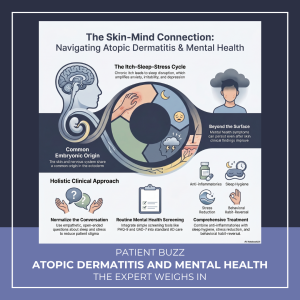
Dermatologists are experts at treating what is visible. But as highlighted in a recent article by Everyday Health, there is an “invisible burden” of atopic dermatitis (AD) that cannot be seen on the skin’s surface: the profound toll it takes on a patient’s mental health.

Because AD is a psychophysiological disorder, psychological stress actually triggers inflammation that worsens flares, creating a frustrating, vicious cycle. Chronic itch and sleep disturbances quickly compound this distress, frequently leading to anxiety, depression, and irritability.

Yet a major gap remains in patient care. Patients often hesitate to bring up their mental health during an office visit, and many dermatologists feel unequipped or too pressed for time to broach the topic.

To bridge this gap, read this Next Steps in Derm interview with Mohammad Jafferany, MD, DFAPA, MCPS, a professor of psychodermatology, psychiatry, and behavioral sciences. He shares practical, clinical insights that every dermatologist can implement today. From understanding the bidirectional connection to normalizing the mental health.

GLP-1 Agonists & Psoriasis Comorbidities

By Video Pearls

GLP-1 agonists

Psoriasis is more than skin deep—it is a systemic inflammatory condition. Jennifer Soung, MD, FAAD, argues that addressing metabolic health is no longer outside the scope of dermatology; it is essential for clinical success.

In a Next Steps in Derm video interview at our sister conference Skin of Color Update, Dr. Soung dives into:

  • The Weight-Biologic Link: How excess weight directly impacts the efficacy of biologic therapies.
  • GLP-1 Agonists: Incorporating modern weight management tools into the psoriatic care plan.
  • The Patient Conversation: Strategies for broaching the sensitive topic of weight with empathy and clinical precision.
  • Comorbidity Management: A comprehensive look at tackling psoriatic arthritis and metabolic syndrome.

Stop treating the skin in a vacuum. Learn how to optimize your patients’ systemic health for better dermatologic outcomes.

Psoriasis and Psoriatic Arthritis in Patients With Skin of Color

By Video Pearls

psoriasis and psoriatic arthritis in patients with skin of color

In a video interview at our sister conference, Skin of Color Update, Mona Shahriari, MD, FAAD, encouraged dermatology clinicians to broaden the psoriasis color palette. She says recognizing the skin tone differences in the presentation of psoriasis can improve diagnosis and care. Dr. Shahriari is associate clinical professor of dermatology at Yale University School of Medicine.

Watch as she shares:

  • The role of biopsy when diagnosing psoriasis in skin of color
  • Challenges in diagnosing psoriatic arthritis in patients with darker skin tones
  • Latest research in treating scalp psoriasis
  • Pigmentary sequelae and the quality of life impact

If you’re committed to providing quality psoriasis care for all of your patients, this is a must-view video.

Pyoderma Gangrenosum and Sweet Syndrome: ODAC Interview

By ODAC Sessions

neutrophilic dermatoses

Neutrophilic dermatoses aren’t commonly addressed in dermatologic continuing education, yet understanding how to diagnose these dermatoses is important. An accurate diagnosis could reveal an underlying autoinflammatory disease.

Watch this Next Steps in Derm video interview with Anthony Fernandez, MD, PhD, FAAD, from ODAC 2025, where he addresses the most common neutrophilic dermatoses that a dermatologist will see in clinic: pyoderma gangrenosum and Sweet syndrome.

Dr. Fernandez shares criteria for making an accurate pyoderma gangrenosum diagnosis. Learn treatment options and why wound healing expertise is key when managing these patients. Find out why Dr. Fernandez says treating Sweet syndrome may be easier than treating pyoderma gangrenosum. Plus hear about a late-onset, autoinflammatory disease that may be an underlying disease in certain patients who present with rashes that are consistent with Sweet syndrome.

Register for ODAC 2026 for more medical dermatology updates.

Patient Buzz: Skin Care After GLP-1 Weight Loss

By Patient Care

skin care after GLP-1 weight loss

GLP-1 agonists are a popular method of losing weight, which is leading to patient questions about skin care after GLP-1 weight loss. In this Next Steps in Derm Patient Buzz, Heather Woolery-Lloyd, MD, FAAD, outlines skincare ingredients that can address skin laxity and textural changes from losing a significant amount of weight. She also addresses in-office procedures and when to refer a patient to a plastic surgeon. Find out her approach with patients who are experiencing significant weight loss and why it’s important to set realistic expectations with patients.

GLP-1 agonists are increasingly used by dermatologists to address comorbidities from inflammatory skin diseases. For more on their dermatologic use, attend the ODAC session, “GLP-1 Agonists in Cutaneous Medicine: Rapid-Fire Insights on Comorbidities, Safety, and Aesthetic Considerations – Panel Discussion”. Register today!

What’s New in Rosacea: Interview with Dr. Adam Friedman

By ODAC Sessions

rosacea

ODAC Co-Chair Adam Friedman, MD, FAAD, says he’s changed the way he approaches rosacea due to some nuances in recently published studies.

Watch this Next Steps in Derm video interview with Dr. Friedman from ODAC 2025 where he addresses what’s new in the understanding of rosacea triggers. Does current research support the longstanding guidance to avoid coffee? Plus learn Dr. Friedman’s top strategies for managing rosacea and find out about three recently FDA-approved rosacea therapies.

Don’t miss Dr. Friedman’s rosacea session at ODAC 2026 where he’ll address more new developments and practical approaches. Register today!

Surgical Reconstruction Pearls

By ODAC Sessions

surgical reconstruction pearls

Think outside the box. That’s the direction of dermatologic surgeon Timothy C. Flynn, MD, FAAD, to dermatologists conducting surgical reconstruction.

Watch this Next Steps in Derm video interview with Dr. Flynn from ODAC 2025 where he shares questions dermatologists should ask when addressing a wound. Find out why considering shadows and highlights is important for positive outcomes and which aspects of beauty to consider when conducting surgical reconstruction.

Register for ODAC 2026 for more surgical dermatology pearls.